
- The MarTech Landscape in 2026
- 5 Marketing Technology Trends for A Better Strategy in 2026
- Hyper-Personalization at Scale
- 2. Maturing AI
- 3. First-Party Data and Privacy-Centric Marketing
- 4. The Convergence of MarTech and AdTech
- 5. Voice Search and More
- Key Data Trends From Taboola’s Perspective in 2026
- Key Takeaways
- Frequently Asked Questions (FAQs)
In 2026, the practice of marketing — automated, personalized, and fast-moving — can only happen successfully with the right technology in place.
The basic tenets of good marketing don’t change much from year to year, but strategies and tactics are both shaped by and influence the technology choices that marketers make. Software options abound and can easily overwhelm a marketing team, even as teams are being asked to reach prospects and demonstrate their contribution to sales more than ever before.
What’s changed in our 2026 update:
- New trends added.
- All entries include updated and current information, advice, and stats.
- Data trends based on Realize data added.
The MarTech Landscape in 2026
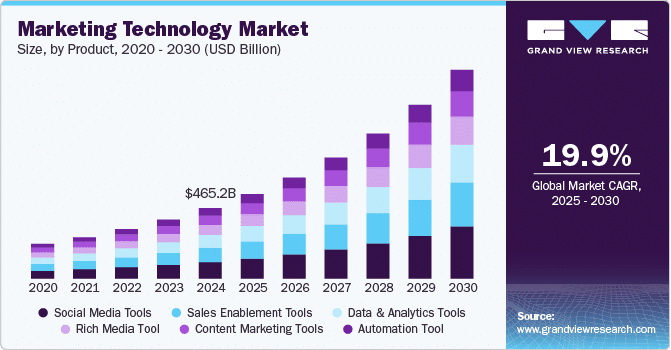
The global marketing technology market size is estimated to be worth a little under $6 billion now, and is projected to reach $2,380 billion by 2033 — a huge compound annual growth rate (CAGR) of 20%. AI and ML are driving this, as well as demand for marketing automation, the need for personalization, a shift toward omnichannel strategies, and the desire for real-time customer insights, among others. While retail and e-commerce are leading the charge, growth is strong among all major categories.
[Source: Grand View Research]
There are a few broad trends in marketing technology in 2026 to shape planning and purchasing for success:
Data-driven
The tools now exist for marketers to collect, refine, analyze, and incorporate tons of data into their marketing tactics. There’s no reason not to make better decisions using all that data, instead of relying on gut instinct or outdated ideas or methods.
Customer-first
Putting the customer first is a tried-and-true tenet of marketing, but technology advancements make it possible in 2026 to truly reach and engage each customer in a cohesive way, using personalization techniques and tools like agentic AI, first-party data, and predictive analytics.
Unified tools
After a few decades of software development, many marketing teams are struggling to get the most out of a mess of disparate legacy technologies. For many, this is the year they’ll unify and simplify the martech stack.
What else to know:
- The global marketing technology market size is expected to reach $2,380 billion by 20333, a CAGR of 20% from 2025.
- The social media tools segment led the market in 2025, making up more than 23% of the global martech revenue.
5 Marketing Technology Trends for A Better Strategy in 2026
If marketing technology in 2026 seems overwhelming, it’s not only because your team is strapped for resources, the budget is tight, or you’re being asked to tackle too many challenges at once: It’s also the sheer volume of the marketplace. The most recent Marketing Technology Landscape report counted 15,384 solutions, up 9% from the previous year. (For some perspective, in 2011, there were just 150 solutions available.)
So, where should a marketer start in identifying and then implementing trending technologies? These following trends can bring a ton of value, and each business will approach adoption their own way based on goals, industry, and budget.
-
Hyper-Personalization at Scale
The convergence of brand importance, AI, big data, and machine learning have led to hyper-personalization as key for modern businesses. Consumers are moving quickly, taking non-linear user journeys across multiple channels per day. It’s essential for marketers to deeply understand their audiences by collecting the right data, segmenting audiences accordingly, and reaching them on their preferred channels with the right messaging and offers.
Using AI-driven technology helps brands to hyper-personalize down to the customer, predicting customer behaviors based on real-time and past data. Marketers can create product recommendations on a landing page, send carefully timed emails during the buying process, and much more. Precise targeting leads to better customer engagement, more effective marketing campaigns, and higher ROI, and understanding customer behavior trends can help marketers make changes quickly and increase conversions. But, solid technology is necessary to do all of this at scale.
Here’s what else to know:
- 81% of consumers ignore irrelevant marketing messages, but 96% are likely to purchase when brands send personalized messages.
- 92% of businesses are using AI-driven personalization to drive growth.
- 56% of consumers say they’ll become repeat buyers after a personalized experience.
2. Maturing AI
It’s ubiquitous in technology conversations in 2026, and for marketing technology in particular, AI offers a ton of opportunity. These include direct prospect or customer interaction, such as in chatbots or customer service agents, as well as workflow process automation. Marketing teams are also starting to hone how they use AI for creative work to scale.
[Source: Ascend2]
AI is generally used for marketing in at least one of these ways:
-
- Generative: Tools like ChatGPT can help marketers brainstorm copy, as well as create imagery and videos. Using AI can help marketers and advertisers scale quickly, testing variations and ensuring human-friendly creative outputs.
- Data work: LLMs offer marketers a way to query datasets in a conversational way, allowing them to incorporate more data into strategy work. Data can be presented simply, showing anything from average ad spend to campaign performance by channel.
- Targeting: AI enables hyper-personalization tactics which, at scale, would likely not be possible for most marketing teams in terms of time and resources.
- Automation: Marketing automation tools often incorporate AI to make it possible to remove the burden of manual tasks from teams, such as automating monthly processes or setting up workflows for repetitive tasks.
- Customer service: AI chatbots have become commonplace as a way for marketing teams to connect with customers at any time without adding to or using tight resources.
- Predictive: With data analytics technology and ML models in place, marketers can forecast results based on detailed past data. Predictive AI technology can offer a huge boost to marketing teams, especially in times of uncertainty, to make better decisions about their strategy.
Here’s what else to know:
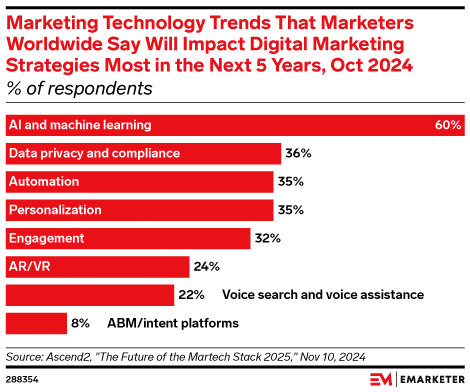
- 60% of marketers say AI and ML will have the biggest impact on marketing strategies in the next five years.
- Marketing teams using AI report 44% higher productivity.
58% of marketers now use AI for content ideation and optimization.
3. First-Party Data and Privacy-Centric Marketing
First-party data has become more essential, and more valuable, in understanding prospects and customers. First-party data comes directly from customers, so it’s more accurate, and collecting first-party data helps businesses stay compliant while building strong, trusting customer relationships. It’s key to privacy-centric marketing, which customers demand and regulatory bodies insist upon.
[Source: The Nielsen Company]
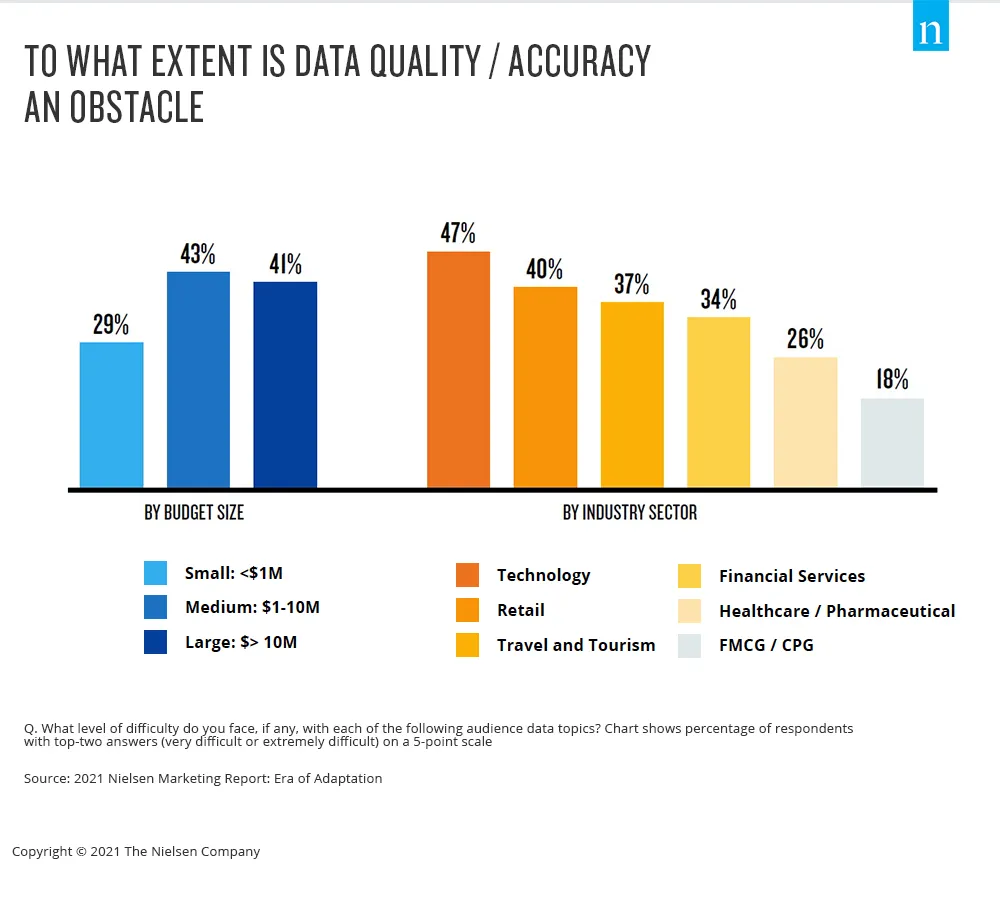
There’s a lot of opportunity to build brand and customer loyalty when gathering this data, as well as using it for better personalization alongside other technology like predictive analytics. A single source of enterprise truth for data — like a customer data platform (CDP) — is the foundation for using customer data wisely. Successful marketers have to make sure that data is continually fresh and integrated, with a company-wide strategy for using data to reach and engage customers. That way, customers will only get the right messages at the right time in their buying journey, and marketers won’t waste time on manual data work. Poor data quality can lead to frustrated customers and unclear campaign results, and it’s also bad for AI success.
Here’s what else to know:
- 86% of companies recognize the importance of first-party data.
- 64% of U.S. customers say they’d provide their email address for a $20 discount, and 31% would share their full name.
- 60% of gen AI projects were abandoned due to poor data quality or unclear business value.
4. The Convergence of MarTech and AdTech
As part of building the data foundation, technology (and the teams using it) has to be integrated and synced across the business. There are many ways to annoy and lose customers with disparate technology siloes — sending multiple unrelated emails in one day, the purchase and return departments unable to communicate, and much more. Many of these common issues stem from separate martech and adtech stacks, whether it’s from lack of internal communications, legacy software tools not working together, or both.
Martech generally refers to the technology and tools that marketing uses, such as a CRM, email marketing, social media marketing, etc. Adtech refers to the tech used for advertising and buying media, including any digital campaigns and optimizing spending. Bringing these platforms together will be essential for AI success, data quality, and customer experience, as well as other point solutions that may exist. The customer experience should be the gold standard for teams building unified stacks, and combining team goals to get to that excellent experience can then help the wider business meet its goals. And, perhaps most importantly, a unified platform saves a lot of wasted budget and resources internally.
Privacy concerns are top of mind in both adtech and martech in 2026, with 73% of consumers saying they’re more concerned about their data privacy now compared to a few years ago.
Here’s what else to know:
- The global ad tech market is projected to reach $1,580 billion by 2030, with a growth rate of 14%.
- Nearly 29% of U.S. ad agencies said they used six to seven ad tech and martech tools as part of their tech stack, and 17% used more than 10.
- Disconnected or misaligned ad tech and martech tools can lead to a 10-13% loss in resources.
5. Voice Search and More
Smart speakers like Amazon’s Alexa and iPhone’s conversational assistant Siri are commonplace among consumers. With these tools established, alongside a robust podcast industry, marketers should consider voice search and commerce as a tactic in their strategy. This may include optimizing content for voice search, using long-tail keywords and natural language.
Voice commerce includes the field of audio marketing, which may include podcast sponsorships or streaming service ads, depending on the product, audience, and industry. As with any of 2026’s marketing trends, marketing teams should use all the data at their disposal, target appropriately, and conduct testing to see what works on this channel.
More broadly, businesses that are willing to experiment and disrupt within their category have seen big gains in the past few years. Technology can play a huge role in disruption and reaching consumers in new, interesting, and authentic ways.
Here’s what else to know:
- 32% of consumers use voice assistants weekly.
- 74% of voice assistant users have completed at least part of a buying process through conversational AI.
- 71% of consumers would rather use voice search than manually typing queries.
- Brands willing to disrupt themselves or their category have created $6.6 trillion in value over the past 20 years.
Key Data Trends From Taboola’s Perspective in 2026
Taboola’s Realize platform brings together AI technology, modern marketing techniques, and data-driven strategy. We’ve seen a few key trends emerge lately:
Human-created and AI-created ads work best in tandem. AI-generated creative work is a lot more common, but humans are much more aware of it, too. A recent study found that AI-generated ads either perform as well as or outperform human-generated ads, with Realize’s AI technology incorporating creative best practices accordingly.
Modern ad success requires data-driven strategies. We’ve found that Realize users who focus on the outcomes up front can make big gains with prospects, especially on the open web. For example, choosing to maximize conversions vs. maximize value before launching a campaign brings a lot more clarity, and specific, action-oriented data to analyze and act upon. Iterating quickly for efficient scale is essential for modern advertisers.
Advertisers have to work at massive scale. It’s not enough for advertisers and performance marketers to create and deploy ad campaigns at a pre-generative AI scale. At Taboola, the numbers show how fast and how massive businesses need to run to attract new users: The Realize platform trains 400 AI models, processes about 2 PB of data, and makes 181 billion predictions each day.
Key Takeaways
Marketing technology reflects the bigger tech landscape in what’s changing the game, with AI, user focus and privacy, and rich data all in the spotlight. Whether teams are building their tech stack from scratch or phasing out legacy tools, customer data should be the focus — capturing it safely, using it responsibly, and making data-driven decisions to succeed.
Frequently Asked Questions (FAQs)
Where is MarTech headed in the next five years?
The next five years offer lots of room for growth and experimentation for marketing technology. Agentic AI, ensuring customer privacy while capturing data, strong data foundations, and hyper-personalization will all continue to mature as marketers access more sophisticated technology and use continuous testing to understand what customers respond to. They’ll need to strike a balance to continue to deeply understand customers while using tools like AI to scale quickly.
What are the trends in voice search optimization for marketers?
Voice search optimization is on the rise, with big implications for traditional SEO practices. Voice search is more conversational than text-based searches, so marketers can use long-tail keywords and make sure they’re optimizing for natural language and the short questions users may be asking their phone or smart speaker. As this segment becomes more commonly used, marketers need to define and track the metrics that fit voice search usage.
How is generative AI being used in marketing?
Marketers are using generative AI to quickly create, test, and iterate on messaging, imagery, and videos, particularly as technology like Realize includes AI that takes into account human preferences. Gen AI offers opportunities for personalization at scale and streamlined workflows, such as removing manual work for email sequences, as well as conversational data analysis to quickly understand campaign performance.


